30 June 2023
To a degree, choosing a skateboard size is a matter of personal preference. However, as a beginner looking for a complete skateboard, some general sizing guidance may help to ensure your ride is stable enough, responsive enough, and comfortable to use.
What is a ‘skateboard’?
This may seem like an odd question, but it is an important distinction to make when choosing a board.
Most ‘skateboards’ fall into one of three broad categories. Which one you opt for will depend on what you are trying to achieve in buying a board, i.e. how you mostly want to use it. The size and shape of the deck will be designed and optimised with a certain riding style in mind.
Classic aka ‘double kick’ boards tend to be on the shorter and narrower side. They’re geared towards ‘street’-style skating: for lovers of big air and performing of tricks.
The double kick moniker comes from the kicktails at both ends of the concave deck, which can be used to ‘pop’ the board when performing sharp pivots, grinds, ollies and kickflips.
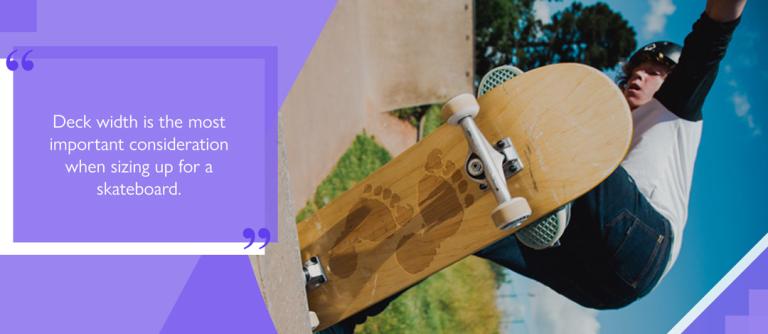
Longboards are designed for extended cruising, ‘carving’ and downhill racing. As the name suggests, these tend to be longer than classic skateboards. They also vary a lot more in terms of shape and length, with different types of noses, tails, and wheel positioning.
Surfskate boards are designed to replicate the feeling of surfing on land. While often compared to longboards, in practice they are stouter and tend to be on the wider side, as maxing out speed is less of a concern than stability and responsiveness.
The following guide is focused specifically on choosing a classic skateboard deck.
Skateboard width is important
While length and wheelbase (the distance between the wheel axles) can affect performance, particularly when considering longboard sizes, it matters less with classic skateboards.
Most classic boards are of comparable length. Whether your feet fit within the deck, while standing side on in your riding stance, is key to being able to control the board effectively.
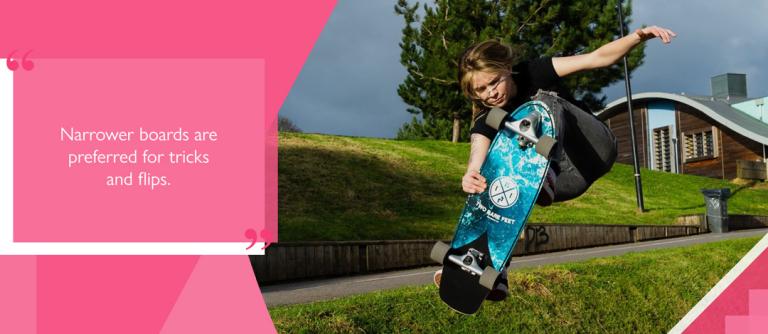
As a broad rule of thumb, narrower boards can make it easier to perform technical tricks and manoeuvres, as they are generally lighter and rotate quicker. Wider boards provide good stability and comfort, making them better suited to cruising.
However, this logic is inverted somewhat when considering tricks that involve jumping large gaps or riding handrails, as a wider deck is generally preferred for these types of activities.
In the end, it will come down to how a skateboard ‘feels’ to the rider. Not everyone will find that these broad rules determine a ‘best fit’ for them.
Determining optimal skateboard deck width
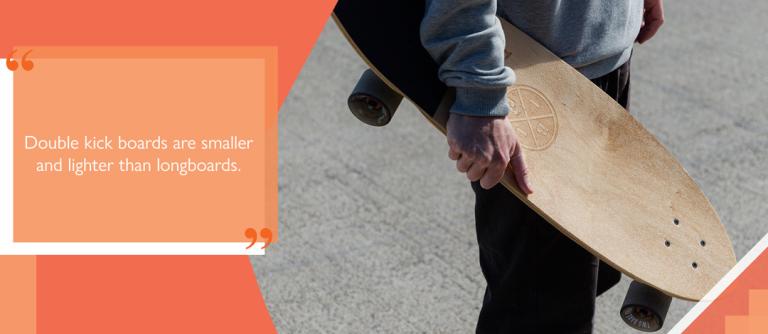
Matching your shoe size to the width of the deck is key.
The width of a classic skateboard for older children and adults typically ranges between 7.75” and 8.5”. The target deck width, shoe size, and indications of whether a deck is too narrow or too wide must be considered when sizing for a skateboard deck.
Is my skateboard deck too wide or too narrow?
The deck needs to accommodate your feet when you are stood in your riding stance. If you are a beginner you may want to skew towards a deck that feels more stable (i.e. a little wide), but you’ll come to understand what works best for you over time.
Narrow deck
If a board is too narrow for your shoe size, your feet will hang over the deck width by several inches. When a board is too narrow, the ride will feel less well balanced and unstable.
Wide deck
The board is too wide if your feet fit comfortably within the deck width. A board that is too big will require the rider to provide additional drive, making the ride inefficient. It will also be difficult to perform tricks.
Good fit
Your shoes should fit the width of the board, with a very slight allowance for overhang (a few centimetres).
Rider size
A board width around 8” can be considered a good ‘starting point’ for new skaters, but one size will not fit all. If you’re larger than a men’s UK size 8 or woman’s UK size 7, you’ll likely want something a bit wider.
Height and weight can also be a factor. Narrower skateboards are better suited to children or smaller adults; wider boards provide more support for taller or heavier riders. Taller riders are also likely to have larger feet.
i
Finding a classic skateboard that fits you
At Two Bare Feet we offer a selection of complete double-kick skateboards that will make you stand out at the skatepark as you perfect those tricks and flips.
Our 31” x 8” classic boards offer a standardised and well-balanced entry point for newcomers, but seasoned skaters are still attracted to the value and performance these boards offer.
The range utilises an affordable and hard-wearing 7-ply deck, made with a sturdy Canadian maple exterior, and an interior layer of Chinese maple. But don’t think that standardised dimensions will crimp your style: the decks come with a host of designs and colours that show off your personality.
For a more premium experience, our laser-etched Two Bare Feet logo boards come in four different widths: 7.75”, 8”, 8.25” and 8.5”, providing skaters of all abilities with an option to suit their shoe size and height.
Featuring a 7-ply deck constructed solely of Canadian maple, you’ll be the envy of your peers thanks to the attractive red-and-yellow stained cross sections and bold yet tasteful logo.
Of course, the performance of a skateboard is a sum of its parts. Our classic boards come with components chosen for reliability and agility, with a range of heavy-duty trucks, durable 50mm–54mm wheels, and ABEC-rated bearings offering longevity and a smooth ride on multiple surfaces.