16 August 2021
Readying the right SUP surfing kit
Select a SUP
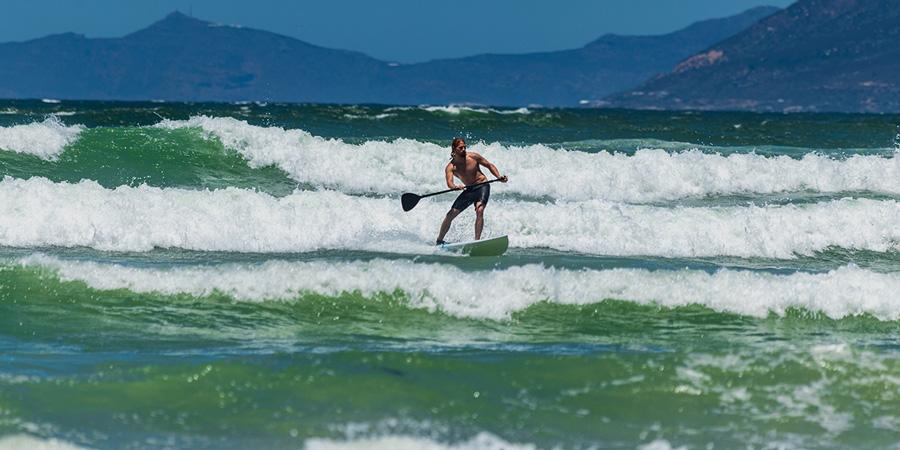
A surfing SUP should be noticeably smaller than one used for touring or racing. They’re more agile and offer better control.
Board shape matters too. Narrower tails make boards less stable, but easier to manoeuvre.
The curvature noticeable at either end of a board, across the nose and tail, is referred to as the rocker. A more pronounced rocker makes dropping in without nosediving easier, and offers increased agility.
As the most common fin set up, a 2+1 fin configuration will help to ‘anchor’ the board to the water, providing a good balance of stability, manoeuvrability and speed.
Quad-fin set ups are also common on SUPs and work well as an alternative.
SUP accessories
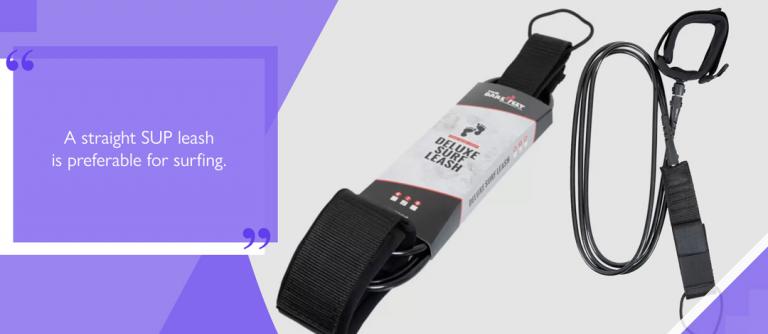
While coiled leashes are more often used in paddleboarding, they can be dangerous for surfing due to the potential for recoil.
A straight leash, roughly the length of your board, is preferable. Any leash you use should be designed specifically for paddleboarding.
Your SUP paddle should be shorter than is usual for paddleboarding – roughly your height. This makes adjustable SUP paddles ideal. Carbon fibre is recommended, as you will need to quickly manoeuvre the paddle and clear it from your body when falling.
SUP surfing technique
Choose your location carefully
It’s best to start small. Learn to SUP surf on small waves, working on your technique and balance before attempting bigger waves.
On a day when strong winds are absent, find areas of gentle waves with small white crests but no big surf. Areas of flat water beside breaking waves make it easier to paddle back out, as strong breaks at beach level quickly become exhausting with larger SUPs.
Learn to surf somewhere free from submerged rocks. If the seafloor is rocky, the water needs to be deep enough to accommodate falling off the board.
Try to find waters that aren’t crowded. This provides more opportunities for waves and ensures you can fall without your board hitting others.
Getting into position for SUP surfing
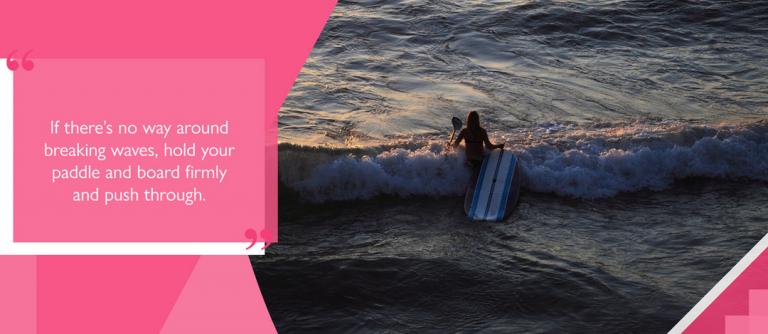
If there’s no way around waves breaking on the beach, hold your paddle and board firmly in each hand, point your board’s nose into the waves, and push through until you’re past where they break. There’s more resistance if the waves hit broadside.
Mount your board when you’re clear or, if the water is calm, whenever you reach a comfortable depth. Tuck your paddle between your chest and the board lengthways, to secure it.
To conserve energy and make balancing easier, hand paddle lying on your front until you can stand without falling.
Catching a wave
When attempting to catch waves, start from a standing position. You can paddle into a wave using a regular SUP stance, using short, sharp strokes to accelerate quickly and match the speed of the wave.
As you feel the wave begin to carry you, jump or step into a surf stance to properly distribute your weight. This means standing in a central position on deck and crouching slightly, while pointing your front foot forwards and back foot outwards.
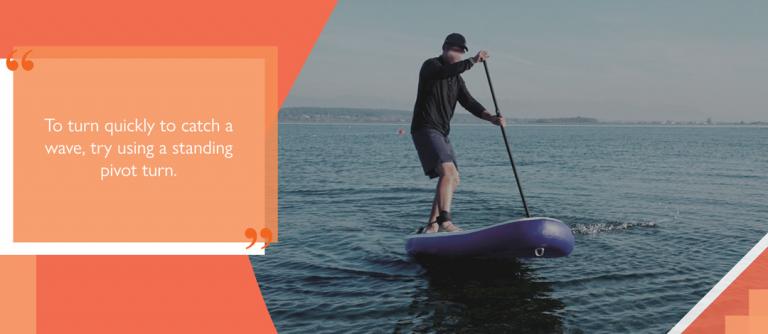
To turn quickly to catch a wave, try using a standing pivot turn. Pivoting halts forward momentum. It takes more energy to build back up but is easier to learn. As you progress, you can turn as you drop in, using the wave’s momentum.
Riding a wave
White water shakes boards more than flat water, making them less steady. Practise riding over gentle cresting waves to get adjusted. Paddle hard as you crest the wave and lean your weight onto your back foot, pushing the board against the wave.
Switch to a surfing stance before dropping in. Transfer your weight to the front foot to dip the nose over the crest and drop in. Immediately on dropping in, transfer weight to your back foot, lifting the nose out of the water to avoid nosediving.
To get out of waves, either kick your board hard up and out, ride the wave until it loses momentum or jump off. Before bailing, check no one will be hit by your SUP.
When attempting to pull out of a wave before dropping in, dig your paddle in behind the wave crest to ease off.
Quality inflatable paddle boards for surfing
Good quality inflatable SUPs are perfect for learning to surf, as they are durable and lightweight. This lightness makes them easier to control than hard boards and safer to fall onto or be hit by, though it’s still best avoided.
For information on choosing an iSUP for surfing, check out our dedicated article on the topic.